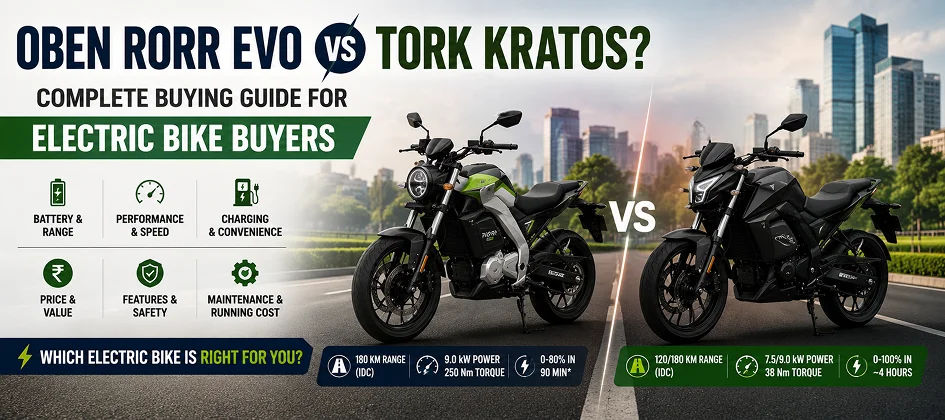
The Indian two-wheeler market is witnessing a steady shift toward electric mobility. Commuters across major cities like Bengaluru, Mumbai, Pune, Delhi, Ahmedabad, and Hyderabad are moving away from traditional petrol commuters due to rising fuel expenses and recurring maintenance costs. Within the electric motorcycle segment, two options frequently cross buyers' minds: the Oben Rorr Evo and the Tork Kratos (and its higher-spec variant, the Kratos R).
Both motorcycles cater to riders looking for a balance between commuting practicality and sporty urban performance. However, they approach electric commuting differently. The Oben Rorr Evo emphasises quick charging, high wheel torque, and LFP battery durability. Meanwhile, the Tork Kratos series focuses on a traditional street-naked aesthetic, balanced power delivery, and an established chassis design.
This buying guide compares the Oben Rorr Evo vs Tork Kratos across price, range, performance, charging, features, maintenance, and long-term running costs to help you choose the right electric motorcycle.
Here is how the two electric motorcycles stack up on paper:
| Specification / Feature | Oben Rorr Evo | Tork Kratos / Kratos R |
| Ex-Showroom Price | INR 124,999 (Introductory: INR 99,999) | INR 129,999 (Kratos) / INR 159,999 (Kratos R) |
| Battery Capacity | 3.4 kWh (LFP Chemistry) | 4.0 kWh (Li-ion NMC Chemistry) |
| Claimed IDC/ARAI Range | 180 km | 120 km (Kratos) / 180 km (Kratos R) |
| Realistic City Range | ~120 – 150 km | ~100 – 120 km |
| Peak Motor Power | 9.0 kW | 7.5 kW (Kratos) / 9.0 kW Peak (Kratos R) |
| Max Wheel Torque | 250 Nm | 38 Nm (Axle Torque) |
| Top Speed | 110 km/h | 105 km/h |
| 0–40 km/h Acceleration | 3.0 seconds | 3.4 seconds |
| Fast Charging | 0–80% in ~90 minutes | Not standard / Limited |
| Standard AC Charging | ~5 Hours (0–100%) | ~4 Hours (0–100%) |
| Kerb Weight | 140 kg | ~140 kg |
| Braking System | Dual Disc with Unified Braking (UBA) | Dual Disc (CBS on base / ABS on Kratos R) |
| Battery Warranty | 8 Years / 80,000 km | 3 Years / 50,000 km |
| Drive Type | Chain Drive | Gear-Driven / Belt Drive |
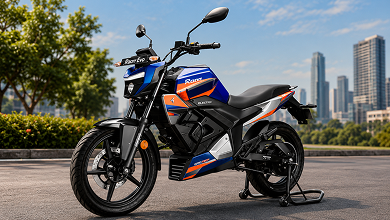
The Oben Rorr Evo is designed as an urban electric motorcycle that balances neo-retro styling with functional performance.
The Rorr Evo features a clean neo-retro silhouette, highlighted by a circular LED headlamp with integrated DRLs, broad tank shrouds, and an exposed trellis frame segment. It offers an upright riding posture suitable for daily city traffic.
Powered by an IPMSM (Interior Permanent Magnet Synchronous Motor) generating 9 kW of peak power and 250 Nm of wheel torque, the Rorr Evo reaches 0 to 40 km/h in 3.0 seconds, with a top speed of 110 km/h.
It utilises a 3.4 kWh lithium iron phosphate (LFP) battery pack. LFP chemistry offers strong thermal stability and extended cycle life, supported by an 8-year/80,000 km battery warranty. The claimed Indian Driving Conditions (IDC) range is 180 km.
The Rorr Evo includes a 5-inch TFT display, smartphone connectivity via Bluetooth, turn-by-turn navigation, geofencing, driver alerts, and an automated fall alert safety system. With a 780 mm seat height, 200 mm ground clearance, and 230 mm water-wading depth, it handles varied urban road conditions cleanly.
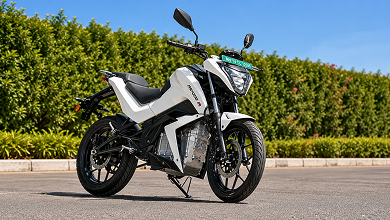
Developed by Pune-based Tork Motors, the Kratos series represents an indigenous street-naked electric motorcycle platform.
The Tork Kratos sports sharp streetfighter styling with angular body panels, an aggressive headlight assembly, and a split-seat arrangement. It presents a sporty, forward-leaning stance.
Equipped with an axial flux motor (labelled as 'Axel Flux'), the Kratos generates 7.5 kW (standard) or 9.0 kW peak power (Kratos R) with 38 Nm of axle torque. It accelerates from 0 to 40 km/h in 3.4 seconds, topping out at 105 km/h.
The motorcycle houses a 4.0 kWh nickel manganese cobalt (NMC) battery pack. The certified ARAI range stands at 120 km for the base Kratos and 180 km for the Kratos R.
The Kratos includes a digital instrument cluster, in-app connectivity, ride analytics, crash alerts, reverse mode, and LED lighting throughout. Safety hardware includes front and rear disc brakes with a Combined Braking System (CBS) on the standard model and anti-lock braking (ABS) options on the higher variant.
Price is a key factor when purchasing an electric bike in India. Below is the current price breakdown:
Oben Rorr Evo: The standard ex-showroom price is INR 124,999, with a limited introductory price of INR 99,999 for early bookings. Depending on state taxes, insurance, and local registration fees, on-road prices typically range between INR 1.10 lakh and INR 1.35 lakh.
Tork Kratos (Base): Starts at an ex-showroom price of INR 129,999, translating to an on-road cost of approximately INR 1.40 lakh to INR 1.48 lakh.
Tork Kratos R: Priced at an ex-showroom figure of INR 159,999, bringing the on-road price close to INR 1.70 lakh to INR 1.78 lakh depending on state road taxes.
(Note: On-road prices vary across cities like Delhi, Bengaluru, Mumbai, and Chennai due to differing state EV policies, insurance tiers, and road tax structures).
While both manufacturers claim maximum range figures of up to 180 km, battery chemistry and real-world efficiency differ.
CLAIMED IDC/ARAI RANGE vs REAL-WORLD ESTIMATED RANGE
Oben Rorr Evo (3.4 kWh LFP)
IDC Claimed: 180 km
Real-World: 120 - 150 km
Tork Kratos R (4.0 kWh NMC)
ARAI Claimed: 180 km
Real-World: 100 - 120 km
Oben Rorr Evo (3.4 kWh LFP): LFP batteries provide thermal resistance and extended charge cycle lifespans. The Rorr Evo yields a real-world range of 120 km to 150 km in mixed eco and city riding modes.
Tork Kratos R (4.0 kWh NMC): Despite a larger 4.0 kWh pack, the NMC chemistry delivers an average real-world range of 100 km to 120 km under standard city commuting conditions.
Factors Affecting Real-World Range:
Actual mileage depends on rider weight, pillion presence, continuous high speeds, stop-and-go city traffic, tyre pressure, elevation changes, and ambient temperatures.
0-40 KM/H ACCELERATION
Oben Rorr Evo :3.0 Seconds
Tork Kratos R: 3.4 Seconds
TOP SPEED
Oben Rorr Evo: 110 km/h
Tork Kratos R: 105 km/h
The Oben Rorr Evo offers instant off-the-line response due to its 250 Nm wheel torque rating, making quick overtakes easy in dense traffic. The Tork Kratos delivers a smoother, linear power delivery, making it predictable for novice riders navigating tight city streets.
Both motorcycles can sustain speeds between 70 km/h and 85 km/h on urban bypasses and motorways. The Rorr Evo offers a slightly higher top speed of 110 km/h compared to the 105 km/h limit of the Kratos.
Charging speed and accessibility determine how seamlessly an EV fits into your daily routine.
FAST CHARGING TIME (0 to 80%)
Oben Rorr Evo: 90 Minutes (Supported)
Tork Kratos R: Not Standard / Limited Support
Oben Rorr Evo: Supports fast charging, reaching 0 to 80% capacity in 90 minutes via compatible 15A fast chargers. A full charge at home using a standard socket takes around 5 hours.
Tork Kratos R: Requires roughly 4 hours for a full 0–100% home charge via a standard domestic plug. Fast-charging options are limited compared to the Rorr Evo.
Both bikes come equipped with modern digital consoles and smart features:
Displays: The Oben Rorr Evo uses a 5-inch colour TFT console, while the Tork Kratos features a fully digital instrument cluster.
Smart Connectivity: Both bikes offer Bluetooth connectivity, companion mobile apps, turn-by-turn navigation, geofencing, ride analytics, and over-the-air (OTA) updates.
Safety Technology: The Rorr Evo includes an automated fall alert mechanism linked to emergency contacts. The Tork Kratos R offers crash alerts along with optional anti-lock braking (ABS).
OBEN RORR EVO |
TORK KRATOS R |
Seat Height : 780 mm |
Seat Height : 785 mm |
Clearance : 200 mm |
Clearance : 165 mm |
Ergonomics : Upright |
Ergonomics : Sporty |
Ground Clearance & Water Wading: The Rorr Evo offers 200 mm ground clearance and a 230 mm water-wading limit, making it well-suited for waterlogged Indian roads during monsoon seasons. The Kratos features standard ground clearance (~165 mm), adequate for typical speed breakers.
Storage Space: The Rorr Evo includes a 4-litre tank storage pod along with a 6-litre under-seat compartment for small personal items, standard tools, or portable charging cables.
Electric bikes offer clear financial advantages over conventional petrol motorcycles:
Energy Costs: Charging a 3.4 kWh or 4.0 kWh battery pack costs between INR 25 and INR 40 per charge (based on standard electricity rates in India), resulting in running expenses under INR 0.30 to INR 0.50 per kilometre.
Service Requirements: Without engine oil replacements, spark plugs, clutch plates, or air filters, routine maintenance focuses on brake pad wear, tyre health, chain tension/belt drive checks, and periodic software diagnostics.
Battery Longevity: Oben’s LFP chemistry paired with an 8-year/80,000 km warranty reduces long-term battery degradation concerns. Tork provides a standard 3-year/50,000 km warranty on the Kratos battery.
Pros:
Competitive introductory pricing starting at INR 99,999 ex-showroom
Thermally stable 3.4 kWh LFP battery paired with an 8-year warranty
Fast-charging capability (0–80% in 90 minutes)
High ground clearance (200 mm) and water-wading limit (230 mm)
Quick off-the-line acceleration (0–40 km/h in 3 seconds)
Cons:
Traditional chain drive requires regular cleaning and lubrication
A single variant layout limits customization choices
Pros:
Distinctive streetfighter aesthetics
Linear, predictable power delivery ideal for beginner riders
Available ABS safety option on higher variants
Low-noise belt drive operation
Cons:
Higher ex-showroom price point (INR 1.59 Lakh for Kratos R)
Slower fast-charging capabilities compared to main rivals
Limited dealer and service footprint in tier-2/tier-3 markets
For regular city commuting covering 30 km to 70 km daily, the Oben Rorr Evo holds a slight edge. Its combination of high ground clearance, LFP battery warranty, integrated storage compartments, and fast-charging support makes it a practical option for navigating monsoon roads and unpredictable traffic.
However, if you prefer a traditional streetfighter riding posture, quieter belt-driven operation, and standard linear power delivery, the Tork Kratos remains a viable city commuter.
Neither motorcycle is designed as a long-distance highway cruiser. Electric two-wheelers in this class are optimised for intra-city transit and suburban commuting.
When planning trips beyond 100 km, consider:
Availability of public 15A sockets or fast-charging networks along your route.
The drop in range when cruising continuously at speeds above 75 km/h.
The Oben Rorr Evo’s 90-minute fast charger makes mid-day top-ups more practical than the longer charging times required by the Kratos.
Evaluating overall value involves looking beyond the initial purchase price to consider total ownership benefits:
VALUE FOR MONEY ASSESSMENT
Oben Rorr Evo: High
Lower Price Point | 8-Yr Battery Warranty | Fast Charging
Tork Kratos R: Moderate
Higher Base Price | 3-Yr Warranty | Standard Charging
The Oben Rorr Evo delivers stronger overall value for money. Priced lower at INR 1.24 lakh (or INR 99,999 introductory ex-showroom), it offers an 8-year/80,000 km battery warranty, 90-minute fast charging, and higher wheel torque output. The Tork Kratos R, priced higher at INR 1.59 lakh ex-showroom, carries a shorter 3-year warranty and lacks rapid-charging options.
The Oben Rorr Evo is well-suited for:
Daily commuters seeking a cost-effective alternative to 125cc–150cc petrol bikes.
Buyers who want long-term peace of mind provided by an 8-year battery warranty.
Riders dealing with rough, flooded, or potholed urban roads.
Commuters who need quick fast-charging capabilities during work hours.
The Tork Kratos appeals to the following:
Riders who prefer aggressive streetfighter styling over neo-retro design.
Buyers seeking an electric bike with an optional anti-lock braking system (ABS).
Commuters who value quiet, low-maintenance belt drives over chain-driven setups.
Both motorcycles represent solid progress in India's performance electric two-wheeler market. Selecting the right model comes down to your budget, charging needs, and preferred design style.
Choose the Oben Rorr Evo if you prioritise lower overall purchase costs, fast charging, durable battery chemistry with extended warranty coverage, and high ground clearance for everyday urban riding.
Choose the Tork Kratos / Kratos R if you prefer streetfighter styling, linear acceleration, ABS braking options, and belt-driven refinement.


Manage reminders, payment status, and renewal dates from one simple app.


Trusted by policyholders to track every renewal.

