





Are you considering stepping into electric mobility without paying full showroom prices? Buying a pre-owned electric car, scooter, bike, or commercial cargo loader is one of the smartest ways to skip initial vehicle depreciation while immediately lowering your daily running expenses. However, evaluating a second-hand EV requires a different set of inspection skills than buying a traditional petrol or diesel vehicle.
What should you check before buying a used EV in India?
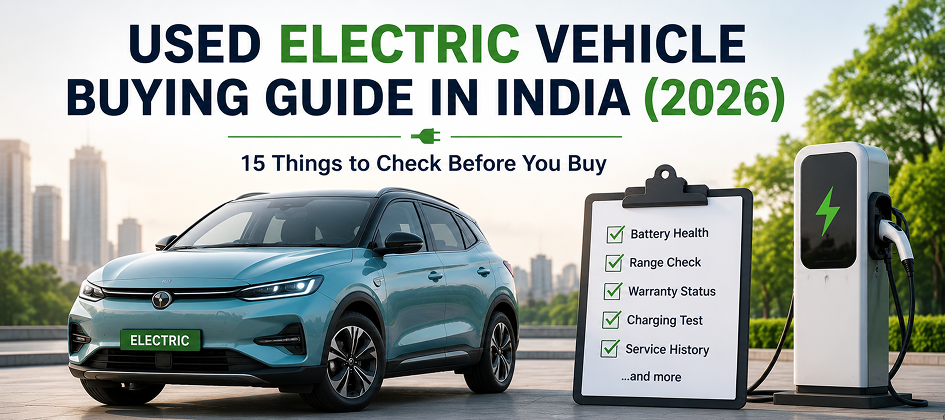
Before handing over a deposit, you must systematically evaluate 15 critical inspection areas:
Battery health & State of Health (SOH) diagnostic report
Real-world driving range vs. original claimed range
Charging system performance (AC slow and DC fast charging)
Active factory battery warranty status & transferability
Official OEM service and maintenance history
Undercarriage, chassis, and accident repair records
Odometer reading consistency across digital logs
Mechanical condition of tyres, regenerative braking, and suspension
High-voltage electrical features and infotainment electronics
Firmware/software updates, telematics, and app connectivity transfer
RTO registration documents, insurance transferability, and hypothecation (loan) status
Number of previous owners and usage patterns
Used-EV market price benchmarks vs. physical condition
Local OEM service center availability and spare parts support
Expected future resale value over a 3-to-5-year horizon
While a petrol car inspection focuses heavily on engine compression, oil leaks, clutch wear, and exhaust smoke, a used electric vehicle buying guide in India centres primarily on high-voltage battery health, thermal management, software logs, and active warranty protection. This step-by-step pre-purchase checklist will help you make a safe, value-driven decision.
Buying a second-hand EV in India offers clear financial advantages, but buyers must balance cost savings against component risks.
Substantially Lower Entry Cost: Skip the initial 30%–40% drive-off depreciation incurred by the first owner over the initial 2–3 years.
Ultra-Low Cost Per Kilometre: Enjoy daily running costs of approximately INR 1.20–INR 1.70/km compared to INR 7.50–INR 9.00/km for petrol vehicles.
Minimal Routine Mechanical Maintenance: No engine oil changes, spark plug replacements, fuel filter swaps, or clutch overhauls.
Higher Vehicle Segment for Less: Access higher-spec variants featuring touchscreens, connected telematics, and advanced safety features at budget pricing.
Battery Degradation: Usable battery pack capacity reduces naturally over time and mileage cycles.
Expiring Warranty Coverage: Buying a vehicle near or past its original 8-year or 5-year factory battery warranty increases financial exposure if a cell module fails.
Rapid Tech Iteration: Older EVs may feature slower onboard AC chargers, older battery chemistries, or discontinued cellular telematics protocols.
Niche OEM Service Risks: Purchasing an EV from an inactive startup can make acquiring replacement body panels or high-voltage components difficult.
Follow this comprehensive used EV inspection guide when viewing any pre-owned electric vehicle.
15-POINT USED EV INSPECTION FLOW
1. Battery Health (SOH) | 2. Real-World Range
3. Charging System | 4. Active Battery Warranty
5. OEM Service Records | 6. Chassis & Underbody Damage
7. Digital Odometer Check | 8. Tyres & Regen Brakes
9. High-Voltage Electronics | 10. OTA Software & Telematics
11. RTO & Loan Documents | 12. Ownership History & Usage
13. Market Price Comparison | 14. Local OEM Service Footprint
15. Future Resale Outlook
What to Check
The traction battery pack is the single most expensive component of an EV, accounting for 35% to 45% of its original manufacturing cost. You must assess the battery’s state of health (SOH percentage), usable energy capacity, and chemistry stability.
Why It Matters
A degraded battery reduces driving range and forces more frequent charging cycles. If a cell module fails out of warranty, replacing the battery pack can cost a significant fraction of the vehicle’s current market value.
How to Check It
Request the seller to accompany you to an authorised OEM service centre (e.g., Tata, MG, Ather, TVS, or Mahindra) for an official diagnostic OBD-II scan report showing the battery SOH%.
For 21-digit Battery Pack Aadhaar Number (BPAN)-labelled batteries, check whether the pack uses LFP (Lithium Iron Phosphate) or NMC (Nickel Manganese Cobalt) chemistry. LFP cells generally demonstrate greater thermal stability and longer cycle life in high Indian temperatures.
Perform a manual State of Charge (SOC) test: note the battery percentage on the cluster, charge the vehicle from 20% to 80%, and check if the percentage scales linearly without sudden jumps.
Warning Signs
SOH reading below 75% on an EV that is younger than five years old.
Rapid drop in battery percentage (e.g., jumping from 35% to 15% instantly while accelerating).
Any history of battery error codes, BMS fault lights, or unrecorded battery repairs.
What to Check
The difference between the manufacturer's certified test range (ARAI/MIDC) and the actual distance the vehicle covers on Indian roads.
Why It Matters
ARAI claims represent ideal lab testing. Real-world range dictates whether the EV meets your daily commuting and weekend trip needs.
How to Check It
Fully charge the vehicle (or note the exact SOC percentage at the start) and reset the trip meter.
Conduct a mixed-traffic test drive covering at least 25–30 kilometres across city traffic and open roads with the air conditioning running normally.
Calculate expected total range using the simple formula:
Estimated Real-World Range = {Distance Travelled (km)/SOC Percentage Consumed (%)} x 100
Warning Signs
Real-world range dropping below 60% of the vehicle’s original factory-claimed specification.
Battery percentage draining rapidly during gentle city driving with AC turned on.
What to Check
The functioning of the onboard charger (OBC), physical charging socket, locking mechanism, and bundled charging accessories.
Why It Matters
A damaged charging port or faulty onboard charger can leave you stranded or prevent slow home charging altogether.
How to Check It
Home AC Charger: Plug the bundled 15A portable charger into a grounded AC socket. Verify that the indicator lights show solid green, the vehicle cluster displays "Charging", and power transfers without tripping the home circuit breaker.
Public DC Fast Charger: Take the EV to a public DC fast station (e.g., CCS2 or GB/T standard). Plug in and confirm that the station negotiates the handshake, locks the gun securely, and initiates high-speed charging without throwing an auto-cutoff fault.
Warning Signs
Burn marks, bent pins, or corrosion inside the charging port socket.
The charging session abruptly stopping after 2–3 minutes.
Missing original 15A portable home charging cable or damaged wallbox hardware.
What to Check
The active status, remaining years/kilometres, and terms of transferability for the manufacturer’s high-voltage battery and drive motor warranty.
Why It Matters
Active factory battery protection (typically 8 years/160,000 km for cars and 3–5 years for electric two-wheelers) acts as a financial safeguard against premature cell degradation or BMS failure.
How to Check It
Inspect the original warranty booklet and call the manufacturer's customer care or dealer with the vehicle identification number (VIN).
Confirm if the original owner complied with mandatory annual service schedules required to keep the battery warranty valid.
Check if extended warranty packages were purchased and whether warranty transfer requires an official name-transfer application at an authorised dealership.
Warning Signs
Lapsed annual service visits, which can void OEM battery warranty obligations.
Third-party electrical accessories spliced into the main wiring harness (e.g., unauthorised horns, aftermarket fog lights, or amplifiers), as these frequently void warranty claims.
What to Check
Digital service records, routine inspection stamps, warranty claim history, and software update logs at authorised brand service centres.
Why It Matters
A complete service history proves proper vehicle maintenance and confirms whether high-voltage recalls or service campaigns were completed.
How to Check It
Ask the seller for complete service invoices or visit the brand's authorised service desk with the owner to pull digital service logs.
Check if coolant flushes for the liquid-cooled battery system, brake fluid changes, and reduction gear oil services were performed at recommended intervals.
Warning Signs
Missing service invoices or long gaps in maintenance history.
Off-grid servicing attempted by uncertified local garages lacking high-voltage safety training.
What to Check
Structural chassis integrity, subframe condition, and crucially, the underbody battery protection casing.
Why It Matters
In Indian road conditions, speed bumps, flying debris, and monsoon waterlogging pose risks to underbody battery enclosures. Physical impacts can compromise internal cell insulation or thermal seals.
How to Check It
Lift the vehicle on a hydraulic hoist at a workshop.
Inspect the structural bottom plate of the battery pack for deep dents, sharp punctures, severe scrapes, or signs of seal tamper.
Check front and rear impact beams, wheel arch liners, panel gaps, and suspension mounting points for weld repair marks or body filler.
Warning Signs
Deep gouges or cracks on the battery enclosure casing.
Fresh rubberised underbody coating applied unevenly to hide impact damage or structural welding.
What to Check
Whether the displayed mileage reflects true vehicle usage or shows signs of electronic tampering.
Why It Matters
Digital odometer tampering can be used to hide heavy commercial usage, fleet mileage, or ride-hailing wear.
How to Check It
Compare the cluster odometer reading against the last mileage recorded in authorised service centre invoices and national digital insurance databases.
Cross-reference physical wear items: heavily worn pedal rubbers, a polished leather steering wheel, and faded seat fabric usually indicate usage over 60,000–80,000 km, regardless of low odometer readings.
Warning Signs
Inconsistencies between the last recorded service invoice mileage and the cluster display.
Refusal by the seller to allow an official service centre diagnostic scan.
What to Check
Tread depth, tyre wear patterns, regenerative braking performance, physical brake pads, and suspension noise.
Why It Matters
EVs carry extra weight due to battery packs and deliver instant motor torque, accelerating tyre tread wear by up to 25% compared to petrol vehicles.
How to Check It
Check all four tyres for uneven edge wear (indicating suspension misalignment or worn bushings).
During your test drive, test regenerative braking levels (low, medium, and high). The vehicle should decelerate smoothly without jerky pedal response or mechanical squealing.
Listen for clunks or groans over rough roads, which can indicate worn strut mounts handling heavy EV curb weight.
Warning Signs
Completely bald tyres requiring immediate replacement (budget INR 20,000–INR 50,000 depending on wheel size).
Reduced or non-functional regenerative braking accompanied by ABS/ESP dashboard warnings.
What to Check
All auxiliary electronics, cabin climate control, instrument cluster displays, lighting, and driver-assistance features.
Why It Matters
Modern EVs rely on a secondary 12V auxiliary battery to power low-voltage control units, contactors, lighting, and infotainment screens. Faulty 12V batteries or short circuits can cause unexpected system shutdowns.
How to Check It
Turn on the vehicle and run the air conditioning at maximum cooling. Confirm that the electric AC compressor kicks in quietly and delivers cold air without drawing excessive battery power.
Test all interior screens, reverse cameras, blind-spot monitors, power windows, and LED headlamps.
Ensure no amber or red warning lights (such as "HV System Fault" or "BMS Error") stay lit on the instrument cluster after boot-up.
Warning Signs
Sluggish touchscreen responses, flickering gauge clusters, or an ageing 12V auxiliary battery showing voltage below 12.2V.
Weak or warm AC airflow (which can indicate compressor or thermal management system issues).
What to Check
Installed vehicle firmware, over-the-air (OTA) update history, and telematics mobile app account ownership transfer.
Why It Matters
An EV relies on software updates for battery management efficiency, charging profiles, and navigation features. Furthermore, connected features (like remote AC control, location tracking, and charge monitoring) require transferring the primary app account to the new owner.
How to Check It
Access the infotainment system menu to verify the current software version.
Confirm that the seller will initiate the official owner-change request via the brand app (e.g., Tata ZConnect, Ather App, or MG i-SMART) to transfer telematics credentials to your phone number.
Warning Signs
Outdated system firmware that fails to download OTA updates.
Unwillingness or inability of the seller to unpair their registered primary mobile account from the vehicle.
What to Check
Registration Certificate (RC), active motor insurance policy, Pollution Under Control (PUC exemption status where applicable), and financial hypothecation clearance.
Why It Matters
Ensures clear legal ownership transfer without outstanding traffic challans, unpaid bank loans, or registration title disputes.
How to Check It
Verify the Vehicle Identification Number (VIN) and Motor Number stamped on the chassis plate against the physical RC book and Parivahan Vahan portal database.
If the vehicle was financed, ensure the seller provides an official Bank No Objection Certificate (NOC) alongside Form 35 to clear hypothecation.
Verify active comprehensive insurance coverage to ensure seamless transfer within 14 days of purchase.
Warning Signs
Mismatched VIN or motor numbers between the physical vehicle chassis and RC document.
Pending bank loans without a valid bank NOC.
What to Check
Number of registered transfers on the RC and how the vehicle was used (private commuting, corporate fleet, or ride-hailing commercial use).
Why It Matters
Vehicles used for commercial ride-hailing or fleet delivery undergo frequent DC fast-charging cycles and rapid mileage accumulation, accelerating wear on battery cells and suspension components.
How to Check It
Check the owner count field on the RC (e.g., 1st Owner vs. 2nd Owner).
Inspect registration classification (Private Green Plate vs. Commercial Yellow/Green Plate).
Ask the seller for their typical charging routine: did they slow-charge overnight at home or rely primarily on commercial fast chargers during peak afternoon heat?
Warning Signs
Multiple ownership changes in a short time frame (e.g., 3 owners within 2 years).
A private vehicle showing signs of commercial fleet usage without documented service logs.
What to Check
Comparing the seller’s asking price against current market valuation listings for identical models, variants, and condition brackets.
Why It Matters
Ensures you pay a fair market price that accounts for vehicle age, battery health, and upcoming maintenance needs rather than an inflated seller valuation.
How to Check It
Check multiple online used-vehicle portals for identical variants of similar age and mileage.
Apply a condition adjustment discount: deduct estimated costs for required tyre replacements, battery health diagnostics, or physical scratch repairs from the seller's asking price.
Warning Signs
An asking price priced suspiciously below market average without a clear explanation (often hiding battery issues, crash history, or loan defaults).
Sellers refusing independent technical inspections by a qualified mechanic or authorised brand dealer.
What to Check
Availability of local OEM-authorised service centres, high-voltage technicians, and spare parts supply chains in your city.
Why It Matters
If you purchase an EV from an inactive startup or a brand with limited local service footprints, sourcing replacement body panels, optical sensors, or battery modules can lead to long repair delays.
How to Check It
Locate the nearest authorised brand service workshop relative to your home or office.
Search online owner forums (such as Team-BHP or EV communities) to gauge local spare parts availability and service turnaround times for that specific EV model.
Warning Signs
No authorised service centre located within a reasonable radius of your location.
Widespread owner reports of months-long delays for basic spare parts or warranty replacements.
What to Check
The expected depreciation curve over your intended ownership period (e.g., 3 to 5 years).
Why It Matters
Understanding long-term value retention helps you calculate your true EV total cost of ownership and plan an effective exit strategy when you decide to upgrade.
How to Check It
Select models from established manufacturers with strong market share and widespread brand trust.
Factor in remaining battery warranty duration: vehicles sold with 2–3 years of remaining factory battery warranty retain higher market value than out-of-warranty units.
For a detailed analysis on value retention, depreciation curves, and 3-to-5-year resale projections across Indian vehicle segments, read our comprehensive guide: Electric Vehicle Depreciation in India (2026): Resale Value After 3–5 Years Explained.
Use this quick summary checklist when inspecting a pre-owned EV in person:
| Inspection Area | Pass / Fail | Inspection Notes & Findings |
| 1. Battery Health (SOH %) | ☐ | Official service center OBD diagnostic report score |
| 2. Real-World Range | ☐ | Calculated test drive range vs original claim |
| 3. Charging Systems | ☐ | Verified AC home slow charger & DC fast port |
| 4. Battery Warranty | ☐ | Valid remaining factory coverage & transfer terms |
| 5. Service Records | ☐ | Complete authorized OEM digital service history |
| 6. Underbody / Chassis | ☐ | Inspected battery enclosure bottom plate for gouges |
| 7. Odometer Integrity | ☐ | Mileage matched against digital service invoices |
| 8. Tyres & Brakes | ☐ | Tread depth checked; smooth regenerative braking |
| 9. High-Voltage Electronics | ☐ | Climate control, AC compressor, cluster error-free |
| 10. Software & App | ☐ | Telematics primary account transfer confirmed |
| 11. RTO Documents | ☐ | RC, VIN match, insurance, Bank NOC verified |
| 12. Ownership Profile | ☐ | Single owner vs multi-owner usage history checked |
| 13. Market Valuation | ☐ | Price compared against regional market listings |
| 14. Service Footprint | ☐ | Nearby authorized service center availability confirmed |
| 15. Resale Potential | ☐ | Evaluated value retention over next 3–5 years |
Before arranging a physical viewing, ask the seller these direct questions:
Why are you selling the EV?
What is the current State of Health (SOH) percentage of the battery pack?
Is the original factory battery and motor warranty still active and transferable?
Has the battery pack ever been opened, repaired, or replaced under warranty?
Where was the vehicle routinely serviced, and are all digital service records available?
Was the vehicle charged primarily via 15A home slow charging or public DC fast chargers?
Is the original 15A home portable charging cable included in the sale?
Has the vehicle been involved in any accident involving underbody impact or frame repair?
Are all electronic features, AC cooling, and connected mobile app functions working properly?
Are there any active bank loans or hypothecation marks on the Registration Certificate (RC)?
How many previous owners are listed on the RC document?
Are you willing to accompany me to an authorised service centre for a pre-purchase diagnostic scan?
Structure your test drive into three distinct phases:
Phase 1: Before Driving
Verify zero warning lights on the cluster during startup.
Note initial battery state of charge and trip meter readings.
Check tyre pressures and inspect physical body panels.
Phase 2: During Driving
Test smooth acceleration across driving modes (Eco, City, Sport).
Check regenerative braking levels and pedal feedback.
Listen for suspension thuds or motor whine over rough roads.
Run climate control AC at max cooling to verify compressor output.
Phase 3: After Driving
Record final battery state of charge and trip distance.
Calculate real-world consumption against battery capacity.
Re-plug the home AC charger to verify the charge handshake.
Checking high-voltage battery health requires accurate diagnostic tools rather than visual estimation.
Authorised OEM Diagnostic Report (Most Reliable): Visit an authorised brand service centre. Technicians plug an OBD-II diagnostic scanner into the vehicle's onboard computer to extract a certified Battery State of Health (SOH%) report, individual cell voltage balance charts, and historical thermal exposure logs.
Real-World Range Consumption Test: Charge the vehicle to 100%, drive 50–80 km under normal traffic conditions with AC running, and record energy consumption per kilometre to calculate total usable pack capacity.
Smart Plug Energy Meter Method: Use a smart socket meter (such as a Tapo P110) during an AC slow-charging session from 20% to 100% to measure actual kilowatt-hours (kWh) drawn from the grid. Compare this against the factory pack rating (adjusting for ~10–15% charging conversion loss) to estimate usable capacity.
Safety Warning: Never attempt to open the high-voltage battery casing, puncture cell modules, or touch orange high-voltage cables yourself. High-voltage DC systems operate above 300V–400V and present severe electrical hazards.
| Factor | Pre-Owned / Used EV | Brand New EV |
| Purchase Price | 30% to 50% lower initial capital investment | Full showroom on-road price tag |
| Initial Depreciation | Already absorbed by the first owner | High drive-off depreciation in years 1–3 |
| Battery Warranty | Partial remaining factory warranty balance | Full 8-year / 5-year fresh factory warranty |
| Battery SOH | Typically 80% to 92% usable capacity | 100% factory-fresh capacity |
| Technology & Features | Previous-generation software and hardware | Latest battery chemistry, software, & speed |
| Financing Interest Rates | Slightly higher pre-owned vehicle loan rates | Standard new-car loan schemes & subsidies |
| Cost Per Kilometre | Equivalent ultra-low daily running cost | Equivalent ultra-low daily running cost |
Verdict: A used EV makes financial sense for buyers seeking low daily running costs without paying full showroom prices. However, if long daily highway commutes demand maximum range and full warranty coverage, a new EV may be worth the extra investment.
| Metric | Pre-Owned Electric Vehicle (EV) | Pre-Owned Petrol Vehicle (ICE) |
| Purchase Price | Moderate (reflects battery age & condition) | Market standard for age and mileage |
| Running Expenses | Very Low (Approx. INR 1.20 – INR 1.70 / km) | High (Approx. INR 7.50 – INR 9.00 / km) |
| Routine Servicing | Low (Brakes, cabin filter, coolant flushes) | High (Oil filters, spark plugs, belts, clutch) |
| Major Expense Risk | High-voltage battery pack degradation | Engine overhaul, transmission gearbox wear |
| Inspection Focus | Battery SOH %, software logs, charging port | Engine compression, oil leaks, exhaust smoke |
| Driving Dynamics | Instant torque, silent cabin, automatic drive | Gear shifts, engine vibration, clutch wear |
Fair pricing for a used electric vehicle in India depends on specific valuation criteria rather than arbitrary discounts:
Baseline Valuation: Start with current market prices for identical models and age brackets.
Deduct for Mileage & Usage: Deduct value for odometer readings above 15,000 km/year or signs of commercial fleet usage.
Adjust for Battery Health (SOH): Deduct value if the battery SOH has dropped below 82% or if the factory battery warranty has expired.
Factor in Maintenance Costs: Deduct costs for worn tyres, body repairs, or missing home chargers.
Fair Used EV Price Calculation:
Fair Used EV Price = Current Market Benchmark Price - (Tyre & Brake Replacement Costs) - (Battery SOH Degradation Discount, if SOH < 80%) - (Out-of-Warranty Financial Cushion)
Buying Purely on Price: Purchasing the cheapest listing without verifying battery SOH or crash history can lead to high battery repair costs later.
Skipping the Battery SOH Check: Relying on visual appearance or cluster readings without getting an official OBD diagnostic scan.
Ignoring Charging Inspection: Failing to test both AC home charging and DC public fast charging before paying.
Neglecting Warranty Transfer: Assuming factory battery warranties transfer automatically without completing required name-transfer forms at authorised dealerships.
Overlooking Underbody Damage: Failing to inspect the bottom battery casing plate for deep impacts or scrapes.
Forgetting Telematics Transfer: Driving home without transferring the primary mobile app account from the previous owner.
Walk away immediately if you encounter any of these red flags during your inspection:
Sellers refusing an authorised service centre battery diagnostic scan.
Deep structural dents, gouges, or cracks on the bottom battery enclosure plate.
Persistent high-voltage system fault lights or BMS error warnings on the dashboard.
Intermittent charging cutoffs during both AC and DC charging tests.
Mismatched VIN or motor numbers on the RC document.
Missing service records alongside a lapsed factory battery warranty.
Severe battery degradation with an SOH reading below 70% on an out-of-warranty vehicle.
Different EV models suit specific buyer requirements:
Daily City Commuting (Scooters & Hatchbacks): Models like the Ather 450X, TVS iQube, Ola S1 Pro, Tata Tiago EV, and MG Comet EV offer practical daily range, compact dimensions, and agile handling for dense urban traffic.
Family & Highway Use (Electric SUVs): Vehicles like the Tata Nexon EV, Mahindra XUV400, MG ZS EV, and Hyundai Kona Electric provide spacious cabins, liquid-cooled battery packs, and CCS2 fast-charging compatibility.
Commercial & Delivery Fleets (Commercial EVs & 3-Wheelers): Electric cargo loaders, electric rickshaws (e.g., Mahindra Treo, Piaggio Ape E-City), and commercial electric vans deliver high payload capacity and fast operational payback for last-mile delivery businesses.
Calculate your complete initial financial outlay beyond the seller's asking price:
Total Initial Investment = Purchase Price + RTO Transfer Fees + Insurance Transfer + Wallbox Installation + {Pre-Purchase Diagnostics
Initial Outlay Breakdown Estimate:
Vehicle Negotiated Purchase Price: INR 750,000
RTO Name & Ownership Transfer Fees: INR 3,000 – INR 6,000
Insurance Policy Name Transfer Fee: INR 1,000 – INR 2,500
Pre-Purchase OEM OBD Diagnostic Scan: INR 1,000 – INR 2,500
Home Charging Socket Wiring Setup: INR 2,500 – INR 5,000
Immediate Wear Items (e.g., Tyres): INR 0 – INR 25,000
Estimated Total Upfront Investment: INR 757,500 – INR 791,000
To learn more about calculating long-term operational savings, energy tariffs, and maintenance expenses, check out our guide on the EV Total Cost of Ownership in India (2026).
Stepping into the pre-owned electric vehicle market in India is one of the most effective ways to lower your daily commuting costs while driving a feature-packed vehicle. However, successful pre-owned EV buyers do not evaluate a vehicle based on appearance alone.
Always follow a systematic evaluation process:
Battery Health ➔ Real-World Range ➔ Charging Test ➔ Active Warranty ➔ Service Records ➔ Underbody Casing ➔ RTO Documents ➔ Market Price
Don't buy a used EV based only on its low price or advertised factory range. Inspect the battery's State of Health (SOH), test both AC and DC charging systems, verify remaining factory warranty coverage, check service records and underbody condition, and complete a thorough test drive before making your final decision.

Manage reminders, payment status, and renewal dates from one simple app.


Trusted by policyholders to track every renewal.

